 |
TRIPLE POST OFFENSE
Back in the 2009-2010 season at William Jewell College, we had the conundrum of
how we were going to run an offense with three post players on the floor at the
same time. Thanks to retired high school coach Bud Lathrop, we were able
to install an offense to take advantage of our situation and to allow our best
big man Nick Larson excel. This was thanks to our triple-post offense.
Thanks to the contributions of Coach Lathrop, we won our conference tournament
and Nick Larson was named a second-team NAIA Division I all-American.
Advantages of the Triple Post Offense
Before installing any offense, the coach should consider the different
advantages and disadvantages. The triple post offense offers some unique
advantages for any team looking to take advantage of particular lineups and to
find more and better ways of getting the ball into the post.
The first advantage that the offense can be used against man or zone defenses.
Because the high and low post areas are occupied on offense when the ball is
passed into the corner, this allows the offense to attack the dead areas of the
zone defense. The triple post offense is most effective against a zone
when run against a 1-3-1, 1-2-2, or 3-2 zone defense.
Another advantage of the offense is that the line-ups that can be various to
take advantage of how the offense is run effectively. If you do not have a
true point guard or if you have either one post player you want to isolate in
the low post or three post players of equal ability, this offense can be used to
your advantage. Since the offense is primarily run from an even-guard
front, having two guards on top allows the offense to be run without a true
point guard unlike the 1-4 high or the secondary break offenses. The
triple-post and single-post continuities allow for the offense to keep the
defense off balance and to keep the game simple for the big people.
The final advantage is that it forces the post players on defense to make
difficult decisions as to how they are going to defend the low post.
Because of the problems faced from the offense, a marginal post player can take
advantage by getting good seals against the defense and by knowing how to take
advantage of the defense's mistakes in defending the post.
Disadvantages of the Triple Post Offense
Despite how seemingly smooth the triple post offense is, there are some
disadvantages that should be weighed before putting hte offense into use.
The first problem with the triple post offense is with weak-side rebounding.
Because the offense usually ends up with four or more players on one side of the
floor, there are not enough players to rebound shots on the opposite side of the
floor.
Second, because the offense does not have many cutters, the players who are on
the perimeter must be threats to score when they touch the basketball. In
particular, the players on the perimeter must be capable of shooting from behind
the three-point line. The post players who will play on the perimeter must
be just as capable of posting up as they are shooting from the outside.
Finally, the triple post offense does not lend itself to being an offense that
can be run out of secondary break. The offense is designed as a half-court
offense so it is not something that can be run when the break fails. If
this becomes your basic offense, you will need to consider pulling the ball out
when the break fails and calling this offense.
Triple Post Continuity
When we set up the offense, we want to start in a 2-1-2 look with the center at
the nail of the free throw line and the two forwards on the low blocks.
When the offense is called out, #3 will cut to the ball-side corner and #5 will
roll to the ball-side low post (Diagram 1). On the pass to the corner, #4
will flash to the ball-side high post.

Diagram
1 |
When the ball is thrown out of the corner to the
ball-side guard, the high post will move to the ball-side low post
and the low post will move to the help-side low post (Diagram 2).
From there, we will look to reverse the basketball as shown in
Diagram 3. Whenever we reverse the basketball, the players
will move to their new spots in the direction of the pass.

Diagram
2 |

Diagram 3 |
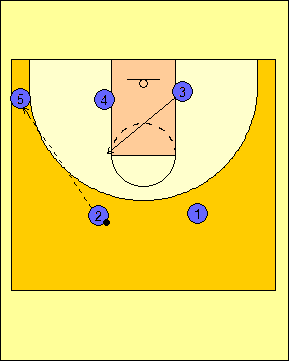
Once again, we see the ball entered into the corner
in Diagram 4. Whenever the ball is entered into the corner, we
will fill the ball-side high post with a flash cut from help-side
low post. When we pass the ball back out of the corner, the
ball-side high post will move to the ball-side low post and the
ball-side low post will move to the help-side low post (Diagram 5).
Diagram
4 |

Diagram 5 |
On the second ball reversal in Diagram 6, we see #4
going to the corner, #3 taking the ball-side low post and #5
occupying the help-side low post. As always, #5 will not move
to the ball-side high post until the ball is passed to the corner
(Diagram 7).

Diagram
6 |

Diagram 7 |
To simplify the continuity for the three-man
continuity, here is how it looks in a more easy-to-understand
concept:
| Starting Point |
Continuity from Starting Point |
| Corner |
Corner
→ High Post → Low Post |
| High Post |
High Post
→ Low Post → Corner |
| Low Post |
Low Post
→ Corner → High Post |
Playing with a Permanent Low Post
When we run the triple post offense with a permanent
post player, we are doing so because we either have a post player we
want isolated in the low post because of deficiency or because they
can dominate in that spot. As always, we start in the same
formation with the triple-post continuity offense as shown in
Diagram 8. From here, we look to enter the ball to #3 in the
corner and flash #4 to the high post once #3 catches (Diagram 9).

Diagram
8 |
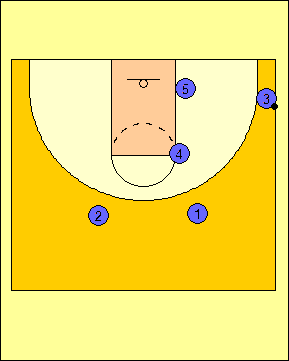
Diagram 9 |
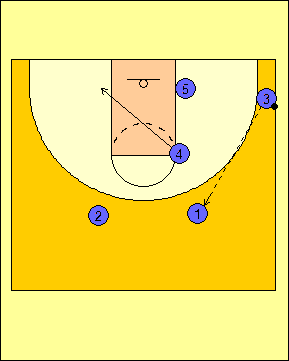
When the ball is passed back to the guards, the
continuity begins. Instead of having the ball-side low post go
to the help side, we will send the high post back to his original
spot (Diagram 10). From there, we will reverse the ball and
continue to run the offense (Diagram 11).
Diagram
10 |

Diagram 11 |
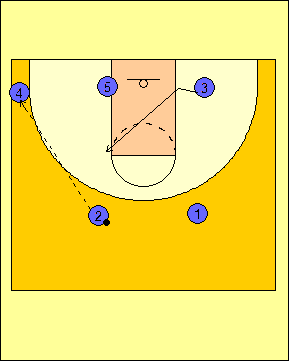
When the ball is passed into the corner to #4 as
illustrated in Diagram 12, we will flash #3 from the help-side low
post to the ball-side high post. When #4 passes the ball back
to the guard on top, #3 will return to his spot before the flash cut
(Diagram 13).
Diagram
12 |
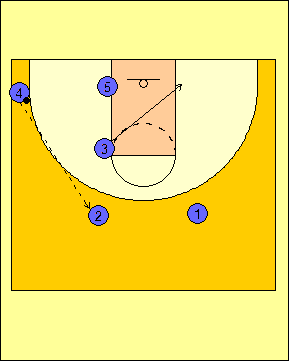
Diagram 13 |
On the second reversal, we still have our three post
players slide along the baseline as the ball is being reversed
(Diagram 14). Once again, Diagram 15 shows the flash to the
ball-side high post from the help-side low post when the ball is
passed into the corner.
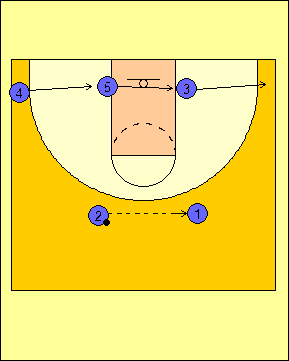
Diagram
14 |

Diagram
15 |
Post Entry
When we enter the ball to the low posts as shown in
Diagram 16, we want the high post to roll to the front of the rim.
This is in case the low post gets double-teamed or does not have a
great scoring angle. The other options for him to pass the
basketball out of the low post are to either guard on top.
In Diagram 17, we show the ball being entered to the
high post from the corner. The first pass look is on the high
low to the low post as he rolls to the basket from his post-up in
the low post area. The other two pass options out are to the
guards on top.

Diagram
16 |
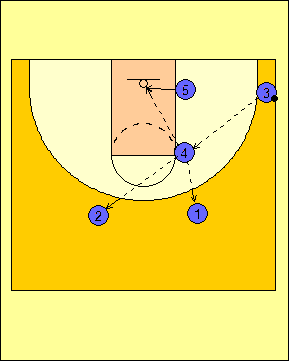
Diagram 17 |
Counters
One of the aspects of the offense that cannot be
understated is the importance of reversing the basketball. If
we cannot reverse the basketball with the pass, we will reverse the
basketball with the dribble. What we do off of the dribble
will be dictated by what the defense does in reaction to the
dribble.
If we are being severely overplayed, we will dive
the opposite guard and look for the backdoor (Diagram 18). If
we cannot get the backdoor, we will have reversed the basketball and
can then pass the ball to the corner.
However, if we cannot get a backdoor because of good
overplay, we will run the shallow cut (Diagram 19). This can
be done either to reverse the ball back after we have reversed the
basketball with the dribble or we can pass the ball to the corner.
Against a sagging defense, we should be able to
reverse the basketball with no trouble whatsoever. If we have
a problem with ball reversal against a sagging man-to-man defense,
we can use the shallow cut.

Diagram
18 |

Diagram 19 |
Teaching the Triple Post Offense
The first way that we teach this offense is with all five players and running
offensive script. This allows our players to work 5-on-0 and to get used
to the responsibilities and continuity of the offense. We have found that
this is the easiest way for us to teach an offense like this.
Breakdown drills are also helpful for our post
players as we help them become accustomed to playing in the offense.
Working initially with 3-on-0 then moving to 3-on-3 allows us the opportunity to
make our big players better and to help them understand the continuity of the
offense.
RETURN TO MEMBERSHIP AREA
© 2010-2017 Alan Peel Enterprises
|
|