Basketball Coaching DVD's at Championship Productions
REBOUNDING
In a sport where every possession matters, it is just as important to get more
possessions than your opponent. In basketball, there are only two ways to
get more possessions: getting fouled on made shots or rebounding better than
your opponents can. Since the former relies on making shots and getting
calls from the officials to go your way, the easiest way to get more possessions
is to rebound more effectively than your opponent.
While many coaches will tell you that rebounding relies on having tall players,
consider these facts for a moment: Jerry Lucas (15.6 rebounds per game),
Wes Unseld (14.0 rebounds per game), Elgin Baylor (13.5 rebounds per game), and
Dennis Rodman (13.1 rebounds per game) are all in the top 10 in NBA history in
rebounding average. All four of these individuals are six-foot-eight and
shorter. All of these players were considered undersized for their
positions, but are among the best rebounders in the history of the game.
The only conclusion that can be drawn from this is that it isn't about size, but
the desire to rebound that set all of these hall of famers apart from other
players of a similar stature.
The drills that will be shown in this article are presented in such a way to
improve a team's rebounding ability and to teach technique.
Rebounding Techniques
It should be noted that the technique that is used to teach rebounding
is different from traditional and conventional methods. Instead of
having all five players block out with their backs to the offensive
players, I have found a more effective method. For defensive
rebounding purposes, the philosophy used by Tom Izzo of "hit, find, and
fetch" has proven to be more effective.
The technique requires the defensive man to "hit" the offensive player
with his forearm, but not to knock him to the floor. This ensures
that the defensive player has inside position for rebounding. The
second part of "find" requires that the defensive player turn and look
to see where the ball is. Finally, "fetch" tells the player to go
get the rebound.
Meanwhile, we teach our offensive players a simple approach: get even
with the defensive player. This can be accomplished by going to
the basket and using a step-over technique to get an advantage to
rebounding the ball. Whether the player goes to the inside or the
outside of the defensive player doesn't matter so long as the offensive
player works to get even.
Regardless of whether we are on offense or defense, we want to rebound
the basketball when it is above the rim. In other words, we want
to rebound the basketball before the ball has a chance to hit the floor.
When a missed shot hits the floor, all bets are off and it can be
anyone's ball. We want the missed shot to be ours and ours only.
Defensive Rebounding Drills
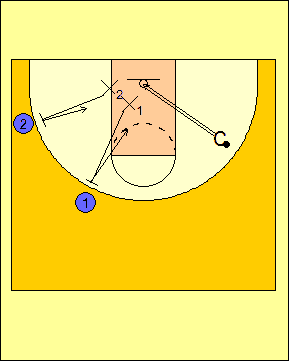
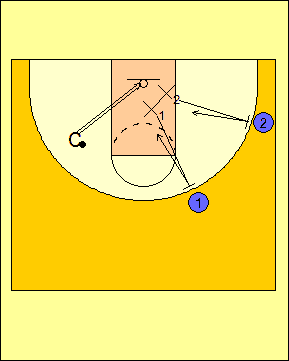
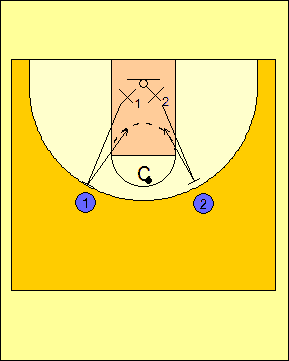
The first drills that we start with are the two-on-two drills shown in
Diagrams 1-3. In each of these drills, we will have two offensive
players go against two defensive players. When we do the defensive
drills, we will have our offensive players stand where they are and stay
stationary. The two players on defense will start with the hands
touching under the basket. On the shot by the coach, they are to
"hit, find, and fetch". We also want to put an emphasis on the
defensive players rebounding the ball above the rim so as to avoid the
ball hitting the floor and the ball being anyone's.
Also, we will vary from where the coach shoots the basketball. If
the coach is on one side of the floor, we want the players to work the
other side of the floor. The reason for this is twofold:
First, the players are likely to start in help defense so their becoming
accustomed to their positioning in help defense will be critical.
Second, it has been studied and discovered that 70 percent of missed
shots from one side of the floor are rebounded on the opposite side of
the floor.
Diagram
1 |

© 2010-2017 Alan Peel Enterprises